You keep a diary.
You read one of the old entries. Now, you see how much you have changed over time, and in which direction.
When time began, the universe had the same problem. From the perspective of the universe, you are doing, but you don’t know where you are going, in which direction.
So the universe did something very smart: it created an up and a down (heaven and earth). Because you need a point of reference.
Without a point of reference, you are still changing, but without any form of control. You want to know whether what you are doing makes sense, whether it's the correct strategy.
The trick with figuring out how a brain works from the inside is that you start in complete chaos. You start without time and causality. Everything is everything at the same time. Then you can decipher it thought by thought, and when there is something wrong, you can figure that out too.
For instance: this thought is nagging me.
What is this thought?
Is it connected to another thought? (Is it like a 1-2 thought, where when I think 1, then 2 follows?)
Is it a thought that exists between two brain regions?
I wouldn't count time as the 4th dimension. You are making it very easy on yourself. Height, width, and depth are not 3 dimensions; they all exist in 1 dimension (spatial).
Then you can count time maybe as a second dimension, as a point of reference and an arrow. You could also argue that time doesn't really exist. We all do things, and how we name it afterwards is what we call time (getting older, for instance). It's everything that happened in the meantime, the whole process. In that sense, time is a lazy metaphor for a big process.
There are thousands and thousands of dimensions more.
The universe and I used the same neat trick. If you start with a thought, for example, and you understand that a thought (often) is a point between two points, now you have created an up and a down (heaven and earth). Now, by understanding, you have created a 4th dimension, which is perspective, which is understanding this. You can use this perspective as an arrow, as time.
Therefore, time in the Bible comes after the spatial dimensions (up and down), which is very smart – and correct. Otherwise, life would interfere with itself.
The universe itself did not start with time. It started with the right timing, which is something completely different. You can only explain that reflectively, with a question. For instance:
“What is the appropriate time to throw a birthday card away?”
At that moment (or a little bit later), the reason you think that at that exact moment is a feeling thing. A timing thing. It plays in your awareness because life has a very good feel for what is appropriate and what is not. So, the moment you realize you are thinking that, it has, in a sense, already happened because the perfect time was before that.
You want to start a universe. You are everything at the same time. And nothing.
How do you begin?
The first problem you run into is that everything is in a kind of perfect balance, where you cannot distinguish separate parts from one another.
It's a bit like coming out of an environment where everyone always talks very negatively about things. You only notice it when you become more positive yourself. Then you think, “Why is everyone here so negative?” Only then do you become aware of the situation before, that you were always surrounded by negativity without realizing it.
This is called consciousness. Consciousness is noticing how much you yourself have changed. And that is very difficult to see from your own perspective. You are just doing things. And then suddenly you think, “Wow, I'm now in the same situation, but I'm reacting very differently.” This means that before, you were actually much more negative yourself than you realized.
The second problem is that you have no limitations. If you are everything, all the way into infinity, you are stuck in an infinite circle that never stops. So you have to limit yourself.
How do you do this? By establishing a beginning. The first point in time.
In modern life, this is somewhat comparable to how overwhelming everything can be. I can now start a thought about almost anything (billions and billions of things), and I can also do anything. I'm typing right now, but I could, so to speak, quit my job, start cooking, do something really weird, or jump out of a window. So you need limitations. You sometimes have to define the boundaries of reality. Because if you do everything at the same time, nothing happens. If I quit my job and jump out of the window at the same time, that doesn't work.
So what do you do? You create a separation between two points. For example, by quitting your job now, cooking later, and then jumping out of the window. This separation is the same as creating a distinction between an up and a down: it is a spatial dimension.
The beautiful thing is that you also immediately have a logical order. You could jump out of the window first, but then you wouldn't be able to cook afterwards. But the first time you start a universe, you don't know this yet. So it could be that the universe had a few false starts, where certain things weren't happening in the right order yet.
Does this sound familiar?
“In the beginning God created the heavens and the earth.”
(You start with an up and a down – this happens simultaneously at one point in time. So it's not that you create the up first and then the down.)
You want to start a universe. You are everything at the same time. And nothing.
How do you begin?
The first problem you run into is that everything is in a kind of perfect balance, where you cannot distinguish separate parts from one another.
It's a bit like coming out of an environment where everyone always talks very negatively about things. You only notice it when you become more positive yourself. Then you think, “Why is everyone here so negative?” Only then do you become aware of the situation before, that you were always surrounded by negativity without realizing it.
This is called consciousness. Consciousness is noticing how much you yourself have changed. And that is very difficult to see from your own perspective. You are just doing things. And then suddenly you think, “Wow, I'm in the same situation now, but I'm reacting very differently.” This means that before, you were actually much more negative yourself than you thought.
The second problem is that you have no limitations. If you are everything, all the way into infinity, you are stuck in an infinite circle that never stops. So you have to limit yourself.
How do you do this? By establishing a beginning. The first point in time.
In modern life, this is somewhat comparable to how overwhelming everything can be. I can now start a thought about almost anything (billions and billions of things), and I can also do anything. I'm typing right now, but I could, so to speak, quit my job, start cooking, do something really weird, or jump out of a window. So you need limitations. You sometimes have to define the boundaries of reality. Because if you do everything at the same time, nothing happens. If I quit my job and jump out of the window at the same time, that doesn't work.
So what do you do? You create a separation between two points. For example, by quitting your job now, cooking later, and then jumping out of the window. This separation is the same as creating a distinction between an up and a down: it is a spatial dimension.
The beautiful thing is that you immediately have a logical order, too. You could jump out of the window first, but then you wouldn't be able to cook afterwards. But the first time you start a universe, you don't know this yet. So it could be that the universe had a few false starts, where certain things weren't happening in the right order yet.
Does this sound familiar?
“In the beginning God created the heavens and the earth.”
(You start with an up and a down – this happens simultaneously at one point in time, so it's not that you create the up first and then the down.)
“Let there be a vault between the waters to separate water from water” means separating yourself from the Other (this is like discovering that you've been in a negative conversation the whole time).
You do your homework.
You eat your ice cream.
You go outside.
Now let's remove time from this comparison.
And let everything happen at the same time.
What does that look like?
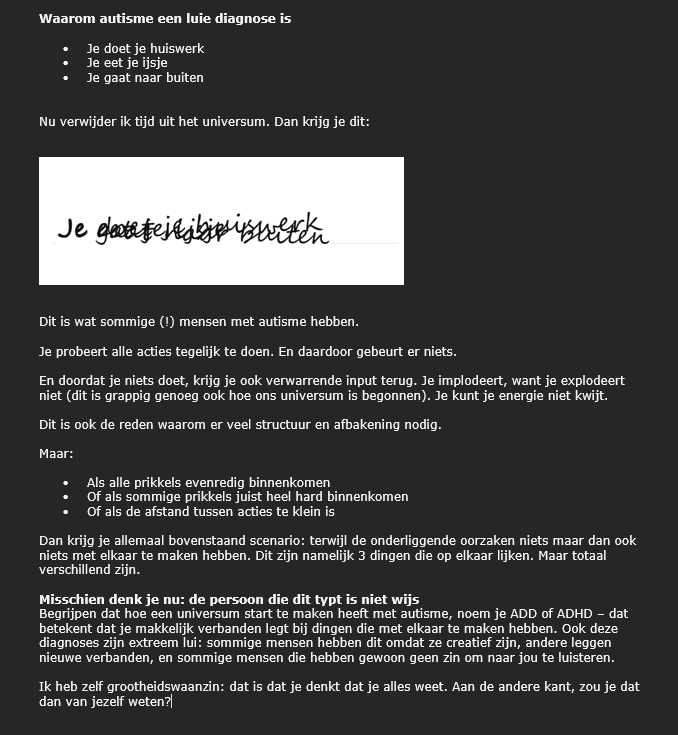
Well, like this:
Sentences written on top of each other.
On the one hand, nothing happens, because you're trying to do everything at once (so, from the outside, you can't clearly see what something is trying to do).
On the other hand, something does happen, because everything begins simultaneously, at multiple points at once.
(From the inside, something is happening: someone is trying to do everything at once.)
So you get an implosion and an explosion at the same time. Let's call that the Big Bang.
This is how a universe begins.
“This isn't smart,” thinks the universe.
“I can do it the other way around. If I am everything at the same time, I'll define my own boundaries first. I'll start with an up and a down. It's all too much.
“If I have an up and a down, I am the point in the middle. So now I have a third point: three dimensions.”
This is also what goes wrong with autism. You try to do everything at once. You have to narrow things down to one action.
The reason autistic people bang their heads against the wall is that they have difficulty defining the boundaries of reality. This causes constant implosions and explosions. So what do you do? You define the boundaries of reality more clearly through rest and routine. You agree on things further in advance.
At that point in time
Sentences written on top of each other
When you remove all dimensions, you get 1D. It looks like this.
Why is this important?
Does autism exist?
Yes, in the sense that there are people who process reality differently.
Yes, in the sense that it's overwhelming.
Why bang your head against a wall?
Because when you can't narrow down reality, you make it as narrow and simple as possible.
You bang your head against the wall. I want this energy that's overwhelming me to be fixed on one specific spot in my head, and I want to transfer it outwards.
People with autism try to do everything at the same time. All actions simultaneously.
No, first, you have to narrow down the actions to one action, or one rhythm (fidgeting, for instance). Because you are overwhelmed.
Because you try to do actions at the same time, you are paralyzed. And you don't do one single action.
Think about how overwhelming this universe is. One second from now, you can think about one of the billions of things you can think about. You can also do any action you want: you can put your arms in the air, you can read a book, or you can jump out of a window. You are choosing from billions and billions of actions.
When this universe started, it had exactly this problem.
You do your homework.
You eat your ice cream.
You go outside.
Now, let's remove time from the equation.
How would it look?
Coincidentally, all sentences started with “you.” But in real life, the sentences don't even start with the same word.
So what happens when you remove time?
On the one hand, nothing really happens, because you try to do everything at the same time.
On the other hand, something happens, since you have tried.
“This doesn't work,” thinks the universe.
How do I start?
I know, I'm going to narrow it down. Because when everything goes on endlessly, nothing really happens at any point in time.
Let me start with an up and a down. I need a good name for those: heaven and earth.
Luckily, I can already separate myself from myself (... “between the waters to separate water from water”). So awareness already exists.
Now, I only need to do one more thing.
I need to remove myself from the equation.
Just like what we did with time.
So first, I'm going to make sure humans are self-aware. Let me trick humans and teach them a lesson.
“You shall not eat of the fruit of the tree that is in the middle of the garden.”
Of course, they took a bite.
“Then the eyes of both were opened, and they knew that they were naked.”
What is the lesson?
The lesson is that curiosity in this universe never, ever, ever, ever gets punished.
Eve made the correct move.
Knowledge of good and bad means that people can make their own decisions, just like animals can (and should).

You start at multiple points in time, in one dimension, and then you layer the 1D images on top of each other later.
Is it a short thought or a long thought?
The Universe’s Greatest Hustle
There are situations in which it is smart to give an answer that you are not sure is ultimately correct, because you don’t know what you don’t know.
The Bible is like that. It’s an approximation.
For instance, my friend is checking me in for a flight. He needs my passport number.
I don’t really know my passport number. But I kind of know my passport number. I just need to check it to make sure. What do you do?
-
You first give the answer you think is true, even though it could be wrong.
-
The information is transferred so that he can take action. He assumes the answer is correct.
-
Meanwhile, you check whether the answer you gave him is correct.
Why? Because this is the fastest way to do it. You set the whole thing in motion first, and then you reevaluate.
If you check your passport first, the whole sequence is more accurate, but it also gets delayed. The start gets delayed.
The problem is that the only way you can do this is if you have really good intuition and an overview of whether this is an appropriate decision to make. Another problem is that if multiple people do this, things will probably get messed up somewhere along the way.
It’s also not the ‘correct’ thing to do. I already know that the answer I give him could be wrong. He needs to readjust if it is. So it’s a matter of trusting each other.
And that, my friends, is how the Bible works too. You do your best. You give an approximate answer that comes closest to the truth, but isn’t necessarily the correct answer.
Why? Because it was the fastest and best way to transfer knowledge. It’s based on intuition and incomplete knowledge.
The funny thing about the Bible is that it’s infinitely smarter than you think it is.
Do you know this riddle?
“A bat and a ball cost $1.10 in total. The bat costs $1.00 more than the ball. How much does the ball cost?”
If you spend an hour’s worth of energy trying to find the answer, you’re going to find it. But the correct answer is 5 cents, because it’s a system based on trust. You need to take into account the amount of energy you spend finding the right answer. Because that’s energy you can’t spend anywhere else (!).
So, in this analogy, the Bible is 10 cents, and science is 5 cents. You need both sides of the coin.
There is no such thing as a correct answer
“A bat and a ball cost $1.10 in total. The bat costs $1.00 more than the ball. How much is the ball?”
The correct answer is 10 cents. But the right answer is 5 cents.
So both answers are correct.
If you incorporate energy expenditure per question and trust into the equation, then the answer is 10 cents. Because normally, this adds up to 1 dollar plus 10 cents, which is $1.10.
If you are willing to spend more energy on the question, you are probably going to say 5 cents.
But I would be able to spend even more energy on this question. The answer could look like this:
-
Numbers don’t really exist in fundamental reality.
-
Since there is energy to spend in the people, animals, and plants around you, 10 cents is an answer that’s more wrong than right.
-
From a sustainability lens, the answer is 10 cents.
-
We choose to go for 10 cents for now, since we always have incomplete information.
I hope the answers AI will give us will be like the latter: you have to make sure to overspend on finding the correct answer, since the correct answer is a balance in the middle, not finding the correct answer.